




Mild abdominal bloating, tightness and localised swelling can occur during your early recovery after robotic prostate surgery. Carbon dioxide used during your operation can contribute during the first few days, while constipation, reduced bowel activity, bruising and normal tissue healing can also make your abdomen feel swollen.
Your symptoms should generally improve rather than become progressively worse. You should seek medical advice if your swelling is increasing or occurs with severe or worsening pain, fever, repeated vomiting, inability to pass wind, wound problems or feeling significantly unwell.
Why Is Gas Used During Your Robotic Surgery?
During your robot-assisted prostatectomy, carbon dioxide is introduced into your abdomen to create working space around your pelvic organs. This gives your surgeon enough working space to see your anatomy and control the instruments within your abdomen and pelvis.
Most of your carbon dioxide is released at the end of your operation, but a small amount can remain temporarily. Your body gradually absorbs the remaining gas during your early recovery.
Can This Gas Make Your Abdomen Look Bigger?
Yes. Residual carbon dioxide and temporary slowing of your bowel can make your abdomen feel tight, full or bloated after your operation.
Your gas-related bloating should normally begin settling within your first few days. If your abdomen becomes increasingly distended rather than gradually improving, you should not assume that residual surgical gas is the cause.
How Long Does Your Gas-Related Swelling Last?
Your gas-related bloating and discomfort are usually most noticeable during your first few days after surgery. Carbon dioxide is gradually absorbed by your body, so discomfort caused specifically by the surgical gas should improve relatively quickly.
Your abdomen may still feel different for longer because your bowel function, bruising and deeper tissues also need time to recover. Persistent or worsening swelling should therefore be assessed according to your other symptoms rather than automatically attributed to gas.
Can Gas Cause Your Shoulder Pain?
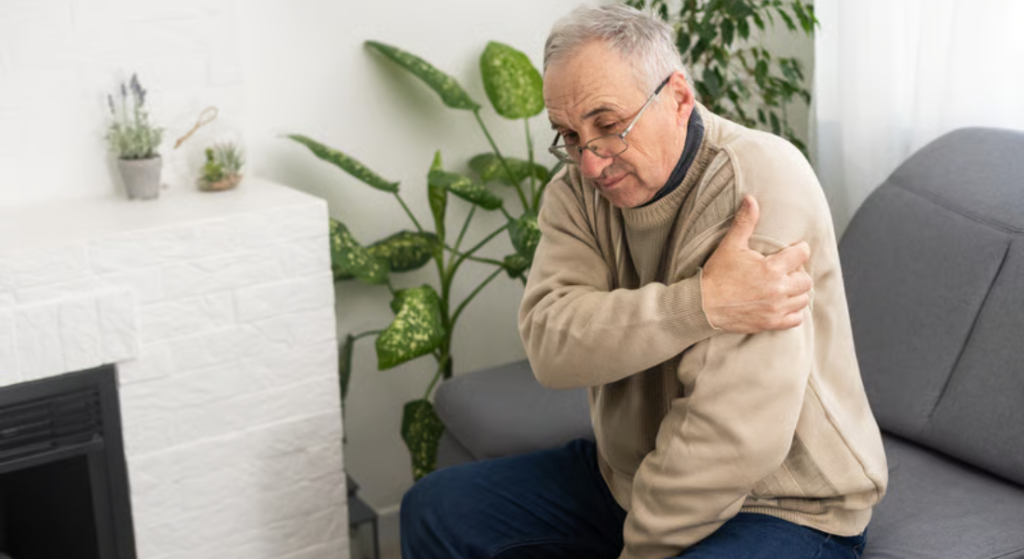
Yes. Carbon dioxide used during your surgery can irritate your diaphragm and cause referred discomfort at one or both shoulders.
Your shoulder-tip pain usually improves during your first few days as the residual gas is absorbed. You should seek advice if your pain is severe, worsening or occurs with chest pain, significant breathlessness or another concerning symptom.
Can Constipation Make Your Abdomen Swell?
Yes. Your bowel may temporarily slow after anaesthetic, surgery, reduced activity and certain pain medicines, which can lead to constipation, wind and abdominal bloating in the first few days after your operation.
- Postoperative slowdown: Your bowel can take time to restart after surgery and anaesthesia
- Common symptoms: Constipation, trapped wind and abdominal swelling may occur
- Typical timing: Your bowels may take around three to four days to open after robotic prostatectomy
- Self-care: Following your discharge advice can help support bowel recovery
- When to seek help: You should contact your team if symptoms become persistent, painful or worsen
These symptoms are usually temporary and improve as your bowel function returns. However, you should seek medical advice if you develop increasing abdominal swelling, significant pain or vomiting, as this may need further assessment.
How Can You Reduce Your Constipation?
You should take any laxatives prescribed by your surgical team as directed and follow your individual advice about food and fluids. Gentle activity can also help your normal bowel movement return.
You should try to avoid straining while opening your bowels during your early recovery. If your bowels remain difficult to manage despite your discharge plan, you should ask your clinical team or GP for advice rather than increasing or adding medicines without guidance.
Does Walking Help With Your Bloating?
Yes. Gentle walking can help your bowel activity return and may reduce discomfort from trapped wind. Moving regularly also supports your circulation during recovery.
You should begin with short, comfortable periods of walking and increase gradually according to how you feel. Your aim should be regular gentle movement rather than pushing yourself through pain or exhaustion.
Can Your Abdominal Wounds Look Swollen?

Yes. You may notice mild bruising, tenderness or localised swelling around your small abdominal incisions while they heal. One of your incisions may also be slightly larger because it may have been used to remove your prostate specimen.
Your wound symptoms should gradually improve. You should contact your clinical team if a wound becomes increasingly red, hot, painful or swollen or begins producing pus, unpleasant-smelling discharge or a large amount of fluid.
What Does Normal Bruising Look Like?
You may develop bruising around your abdominal wounds after surgery, and its colour may change as it gradually resolves. Some bruising or swelling may also track down towards your penis or scrotum because of gravity.
Your bruising should become less noticeable over time. You should seek medical advice if it is rapidly expanding, associated with marked swelling or increasing pain, or occurs alongside dizziness, weakness or significant bleeding.
Can Your Penis or Scrotum Become Swollen Too?
Yes. Temporary bruising and swelling around your penis and scrotum are recognised after radical prostatectomy. Your swelling may develop as postoperative fluid and bruising move downwards under gravity.
Your swelling should generally improve during the following days or weeks. You should contact your clinical team if it is severe, getting worse, very painful, hot or associated with redness, fever or feeling unwell.
Can Fluid Collect After Your Lymph Nodes Are Removed?
Yes. If pelvic lymph nodes are removed during your operation, lymphatic fluid can occasionally collect within your pelvis. This collection is called a lymphocele.
A small lymphocele may cause you no symptoms and require no treatment. A larger or infected collection can cause pelvic discomfort, swelling, pressure or other symptoms and may sometimes require drainage.
What Symptoms Can a Lymphocele Cause?
Your symptomatic lymphocele may cause pelvic or lower abdominal discomfort, pressure or swelling. Depending on its size and position, you may also develop leg swelling, urinary symptoms or other effects caused by pressure on nearby structures.
You should tell your surgical team about any new or persistent swelling after lymph-node removal, as imaging may be needed to confirm the cause.
Common Symptoms of a Lymphocele
| Symptom | What It Means | What To Expect |
| Pelvic discomfort | A feeling of aching or heaviness in the pelvic area | May be mild or more noticeable depending on size |
| Lower abdominal swelling | Visible or felt swelling in the lower abdomen | Can develop gradually after surgery |
| Pressure sensation | Fullness caused by fluid pressing on nearby tissues | Often worsens as the lymphocele enlarges |
| Leg swelling | Fluid pressing on veins or lymphatic drainage pathways | Usually affects one or both legs |
| Urinary symptoms | Pressure on the bladder or urethra | May cause frequency, urgency or difficulty passing urine |
| Persistent swelling | Ongoing or increasing swelling after lymph-node removal | May require imaging to confirm diagnosis |
Can Your Surgery Cause Longer-Term Lymphatic Swelling?
If your pelvic lymph nodes are removed, your lymphatic drainage may occasionally be affected and you may develop lymphoedema. You may notice persistent swelling in your leg, genital area or around your pubic region.
You should have new, persistent or increasing swelling assessed rather than assuming that it is part of normal healing. Your clinical team can determine whether your swelling is caused by lymphoedema, a lymphocele, a blood clot or another postoperative problem.
Could Your Abdominal Swelling Be a Hernia?

You may develop a hernia at one of your abdominal incision sites or in your groin after prostate surgery. You may notice a new lump or bulge that becomes more obvious when you stand, cough or strain and may become less noticeable when you lie down.
You should have a new or enlarging lump assessed, particularly if it becomes painful or firm. You should seek urgent medical help if your lump becomes severely painful or occurs with vomiting, increasing abdominal swelling or an inability to pass wind or open your bowels.
When Could Your Swelling Suggest an Infection?
You should seek medical advice if your wound or surrounding swelling becomes increasingly red, hot, painful or tender or begins producing pus or unpleasant-smelling discharge.
You should also contact your clinical team if these changes occur with fever, chills, shivering or feeling increasingly unwell. Your postoperative infection may require assessment and treatment rather than being managed as ordinary wound swelling.
When Is Your Abdominal Pain More Concerning?
Some abdominal discomfort is expected after your operation, particularly around your wounds and during your first few days of recovery. Your pain should generally become easier to manage as you heal.
You should seek medical assessment if your abdominal pain becomes severe, persistent or progressively worse, particularly when it occurs with increasing distension, repeated vomiting, fever, wound changes or feeling significantly unwell.
What If You Cannot Pass Wind or Open Your Bowels?
Your bowel may take several days to return to its normal pattern after surgery, so a temporary delay in opening your bowels does not necessarily indicate a complication.
You should seek prompt medical advice if you cannot pass wind and your abdomen is becoming increasingly swollen or painful, particularly if you are also vomiting or unable to eat or drink. Your symptoms could indicate postoperative ileus or another bowel problem rather than ordinary constipation.
What If Your Catheter Stops Draining?
Your lower abdominal pain or fullness may occasionally be caused by your catheter not draining properly. You should check that your drainage bag is below your bladder and that your catheter tubing is not kinked or twisted.
You should contact your surgical team urgently if your catheter stops draining, appears blocked or falls out, particularly if your bladder feels painfully full. You should not flush, remove or attempt to reinsert your catheter yourself unless your specialist urology team has specifically instructed you to do so.
Which Symptoms Need Urgent Medical Advice?
You should obtain prompt medical advice if your abdominal swelling is rapidly increasing or occurs with severe or worsening pain, fever, repeated vomiting, inability to pass wind, wound redness or discharge, significant bleeding or a catheter that is not draining.
You should seek emergency medical help if you develop chest pain, severe or sudden breathlessness, fainting or a painful swollen leg because these may indicate a serious complication such as a blood clot.
What Can You Do at Home?

You should follow your discharge instructions, take your prescribed medicines as directed and use any laxatives provided by your surgical team according to their instructions. Gentle walking can support your circulation, bowel recovery and reduction of postoperative bloating.
You should drink according to your individual postoperative advice and avoid heavy lifting while your tissues heal. You should not repeatedly press, massage or attempt to drain a new lump or area of swelling unless your clinical team has specifically instructed you to do so.
UK Guidance Note
Mild bloating, bruising and genital swelling can occur during your recovery after robot-assisted radical prostatectomy. Your symptoms should generally improve with time, gentle mobilisation and appropriate postoperative care.
You should not assume that persistent or worsening abdominal swelling is simply retained surgical gas. Your surgical team may need to exclude infection, constipation or ileus, catheter obstruction, bleeding, lymphocele or another postoperative complication when your symptoms do not follow the expected recovery pattern.
Myth vs Fact
| Myth | What You Should Know |
| Your swollen abdomen is always caused by surgical gas. | Your bowel function, bruising, tissue healing or a complication may also cause swelling. |
| Your surgical gas should remain for several weeks. | Your gas-related discomfort usually improves during your first few days. |
| Your inability to open your bowels for one day means something is wrong. | Your bowels may take several days to return to normal after surgery. |
| Your inability to pass wind with vomiting is ordinary constipation. | Your worsening distension, vomiting and inability to pass wind require prompt assessment. |
| Your genital bruising always means internal bleeding. | Your penis and scrotum can become temporarily bruised or swollen during normal recovery. |
| Your lymphocele will always cause obvious abdominal swelling. | Your small lymphocele may produce no symptoms at all. |
| Your new postoperative bulge is always normal wound swelling. | Your new or persistent bulge may need assessment for a hernia or another cause. |
| Your worsening wound redness is part of normal healing. | Your increasing redness, heat, pain or discharge may indicate infection. |
| Your catheter problem cannot cause abdominal discomfort. | Your blocked catheter may cause increasing bladder fullness or lower abdominal pain. |
Final Thoughts: Abdominal Swelling After Robotic Prostate Surgery
Mild abdominal bloating, tightness or localised swelling can be part of your early recovery after robotic prostate surgery. Gas-related bloating usually improves during your first few days, while temporary bowel changes, bruising and tissue healing may take longer to settle.
However, it is important to monitor your symptoms and recognise when swelling may need medical attention. If your symptoms are worsening, persistent or associated with pain, fever or difficulty passing urine or stool, you should seek medical advice. If you would like to discuss prostate symptoms, PSA changes, treatment options or robotic prostate surgery in London, you can get in touch with our team at Prostate Clinic London to arrange an initial consultation and receive personalised advice.
Key Takeaways
- Your abdominal bloating can occur because carbon dioxide is used during robotic surgery.
- Your gas-related discomfort usually improves during your first few postoperative days.
- Your constipation or temporarily slowed bowel function may also cause abdominal distension.
- Your shoulder-tip pain can result from irritation caused by carbon dioxide used during surgery.
- Your abdominal wounds may have mild localised bruising or swelling while they heal.
- Your penis or scrotum may temporarily become bruised or swollen.
- Your lymph-node removal can occasionally lead to a lymphocele or lymphatic swelling.
- Your new abdominal or groin lump should be medically assessed rather than assumed to be normal swelling.
- Your inability to pass wind with increasing abdominal swelling or vomiting needs prompt assessment.
- Your severe breathing difficulty, chest pain or symptoms of a blood clot require urgent medical help.
References
- British Association of Urological Surgeons (2024) Robotic-assisted radical prostatectomy (RARP). Published March 2024, leaflet O24/103. Available at:
https://www.baus.org.uk/patients/information_leaflets/180/roboticassisted_laparoscopic_removal_of_prostate_for_cancer_rarp - Cambridge University Hospitals NHS Foundation Trust (2024) Robotic radical prostatectomy: pre- and post-operative information. Approved 10 May 2024. Available at: https://www.cuh.nhs.uk/patient-information/robotic-radical-prostatectomy/
- May, M., Gilfrich, C., Bründl, J., Ubrig, B., Wagner, J.R., Gloger, S., Student, V. Jr, Merseburger, A.S., Thomas, C., Brookman-May, S.D. and Wolff, I. (2024) ‘Impact of peritoneal interposition flap on patients undergoing robot-assisted radical prostatectomy and pelvic lymph node dissection: a systematic review and meta-analysis of randomized controlled trials’, European Urology Focus, 10(1), pp. 80–89. Available at: https://pubmed.ncbi.nlm.nih.gov/37541915/
- National Institute for Health and Care Excellence (2018) Venous thromboembolism in over 16s: reducing the risk of hospital-acquired deep vein thrombosis or pulmonary embolism. NICE guideline NG89. Last updated 13 August 2019 and last reviewed 18 September 2024. Available at: https://www.nice.org.uk/guidance/ng89
- NHS (2023) Laparoscopy (keyhole surgery). Page last reviewed 20 December 2023. Available at: https://www.nhs.uk/tests-and-treatments/laparoscopy/
- NHS (2026) DVT (deep vein thrombosis). Page last reviewed 30 April 2026. Available at: https://www.nhs.uk/conditions/deep-vein-thrombosis-dvt/
- NHS (2023) Pulmonary embolism. Page last reviewed 25 May 2023. Available at:
https://www.nhs.uk/conditions/pulmonary-embolism/ - Özdemir, A.T., Altinova, S., Koyuncu, H., Serefoglu, E.C., Cimen, I.H. and Balbay, D.M. (2014) ‘The incidence of postoperative ileus in patients who underwent robotic assisted radical prostatectomy’, Central European Journal of Urology, 67(1), pp. 19–24. Available at: https://pubmed.ncbi.nlm.nih.gov/24982775/
- Prostate Cancer UK (2024) Surgery: radical prostatectomy. Updated July 2024. Available at:
https://prostatecanceruk.org/prostate-information-and-support/treatments/surgery - University College London Hospitals NHS Foundation Trust (2026) Preventing surgical wound infections. Page last updated 10 March 2026. Available at:
https://www.uclh.nhs.uk/patients-and-visitors/patient-information-pages/preventing-surgical-wound-infections - Meenderink, J.J.L. et al. (2023) ‘Lymphoceles after pelvic lymph node dissection during robot-assisted radical prostatectomy’, Translational Andrology and Urology, 12(11), pp. 1622–1630. Available at: https://pmc.ncbi.nlm.nih.gov/articles/PMC10719774/
- Fernando, H., Garcia, C., Hossack, T., Ahmadi, N., Thanigasalam, R., Gillatt, D., Leslie, S., Doeuk, N., Smith, I. and Woo, H.H. (2019) ‘Incidence, predictive factors and preventive measures for inguinal hernia following robotic and laparoscopic radical prostatectomy: a systematic review’, The Journal of Urology, 201(6), pp. 1072–1079. Available at: https://pubmed.ncbi.nlm.nih.gov/30730406/