




Grade Group 1 is the lowest prostate cancer grade and corresponds to a Gleason score of 3+3=6. These cancers usually grow slowly and have a low risk of spreading, particularly when they are localised and other results indicate a favourable risk profile.
Many men with Grade Group 1 prostate cancer are offered active surveillance rather than immediate surgery or radiotherapy. Your PSA level, clinical stage, MRI findings, amount of cancer in the biopsy and general health will help determine whether monitoring is suitable.
What Does Grade Group 1 Mean?
If you have been diagnosed with Grade Group 1 prostate cancer, it is natural to have questions about what this means. Grade Group 1 is the lowest of the five prostate cancer Grade Groups, and it usually indicates a slow-growing cancer with a low risk of spreading.
- The Lowest Grade Group: Grade Group 1 is the lowest prostate cancer grade and contains separate, recognisable cancerous glands that retain more of the structure seen in normal prostate tissue.
- Usually Slow Growing: These cancers tend to grow and spread more slowly than higher-grade prostate cancers.
- Often Part of a Lower-Risk Profile: Grade Group 1 is associated with favourable cancer biology, but overall risk also depends on the PSA level and clinical T stage.
- Treatment May Not Be Needed Straight Away: Many men with Grade Group 1 prostate cancer are suitable for active surveillance rather than immediate treatment.
Understanding your Grade Group can help you make informed decisions about your care. Your specialist will explain what your results mean and recommend the most appropriate management plan based on your overall health and individual circumstances.
How Does It Relate to the Gleason Score?
Grade Group 1 corresponds to a Gleason score of 3+3=6. In prostate needle-biopsy reporting, the first number represents the predominant cancer pattern and the second represents the highest-grade other pattern identified. If only one pattern is identified, the same pattern is used for both numbers.
In Grade Group 1, both reported patterns are Gleason pattern 3, with no pattern 4 or 5 identified in the graded tissue. The result is based on the tissue sampled, so it cannot completely exclude a higher-grade area elsewhere in the prostate.
Why Does the Gleason Score Start at 6?
You may wonder why a Gleason score of 6 represents the lowest Grade Group. Although the original Gleason system included patterns from 1 to 5, patterns 1 and 2 are not normally used when prostate cancer is diagnosed from a modern needle biopsy. The lowest score usually reported is therefore 3+3=6.
Although the number 6 may sound like a middle-range result, Gleason 3+3=6 corresponds to Grade Group 1, the lowest category normally assigned to diagnosed prostate cancer. Your PSA level, clinical stage, MRI findings and the amount of cancer found are still needed to understand your overall risk.
What Does Grade Group 1 Cancer Look Like Under the Microscope?
Grade Group 1 cancer forms separate, recognisable glands that retain more of the gland-forming architecture seen in normal prostate tissue. This architecture is classified as Gleason pattern 3.
Grade Group 1 cancer generally behaves less aggressively than cancers containing Gleason pattern 4 or 5. However, grade is only one part of the assessment, and your PSA level, clinical stage, MRI findings and amount of cancer found must also be considered.
How Is Grade Group 1 Diagnosed?
Grade Group 1 is diagnosed when a pathologist examines prostate tissue collected during a biopsy and identifies only Gleason pattern 3 in the graded cancer. The report may also describe how many samples contain cancer and how much cancer is present in each sample.
A biopsy examines only selected areas of the prostate, so the result provides an estimate of the cancer across the gland. MRI can help target suspicious areas, but only microscopic examination of tissue can determine the Grade Group.
Can an MRI Confirm Grade Group 1?
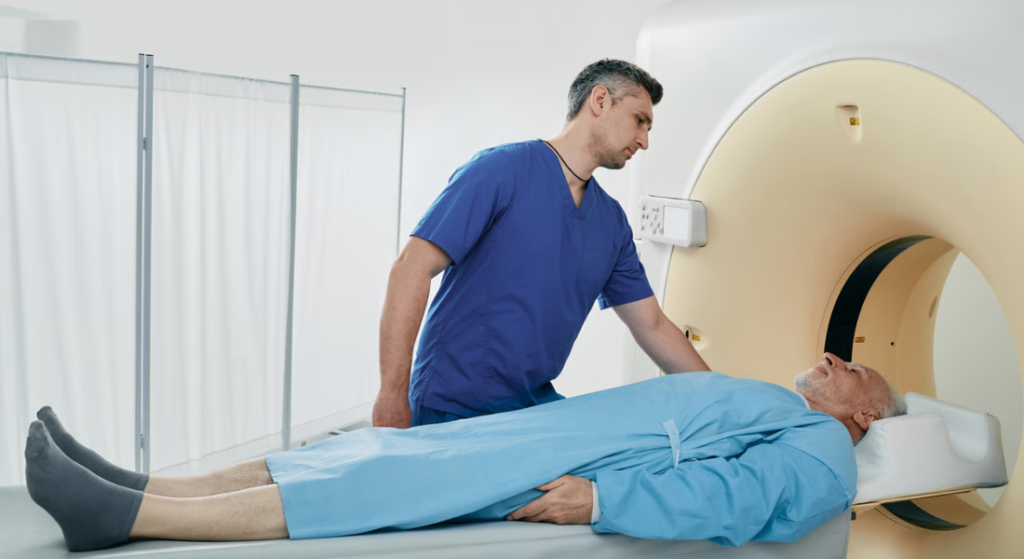
MRI can identify suspicious areas, estimate tumour size and help assess whether cancer may extend beyond the prostate. It can also guide the biopsy towards areas that are more likely to contain clinically significant cancer.
MRI cannot confirm Grade Group 1 because it does not show the microscopic glandular architecture used to assign the Grade Group. Tissue must be examined by a pathologist to determine the Grade Group.
Is Grade Group 1 the Same as Stage 1?
You may think that Grade Group 1 and Stage 1 mean the same thing, but they describe different aspects of prostate cancer. Grade Group describes the cancer’s microscopic growth pattern and glandular architecture, while stage describes its extent, including whether it remains within the prostate or has spread.
Your healthcare team will consider both your Grade Group and cancer stage when planning your care. Looking at both gives a clearer picture of how the cancer is behaving and the most appropriate management for you.
Is Grade Group 1 Always Low Risk?
Grade Group 1 usually indicates favourable cancer biology, but it does not determine your overall risk or management on its own. The Cambridge Prognostic Group combines the Grade Group with your PSA level and clinical T stage. The amount of cancer found in biopsy samples and your MRI findings may also influence whether active surveillance is appropriate.
Your specialist will therefore consider all of your results rather than assuming that every Grade Group 1 cancer should be managed in the same way.
What Is Cambridge Prognostic Group 1?
Cambridge Prognostic Group 1 includes Grade Group 1 or Gleason 3+3=6 prostate cancer, a PSA level below 10 ng/ml and a clinical stage of T1 or T2. All three criteria must be present.
Grade Group 1 cancer with a PSA between 10 and 20 ng/ml would normally be classified as CPG 2 when it remains stage T1 or T2. Cancer staged as T3 would be placed in a higher CPG even if the biopsy showed Grade Group 1.
What Is the Outlook?
Your outlook with Grade Group 1 prostate cancer is generally very good. Several factors help your healthcare team assess your prognosis and decide whether active surveillance or treatment is the most appropriate approach. The table below summarises the main factors that influence your outlook.
| Factor | What It Means | Impact on Outlook |
| Grade Group | Grade Group 1 (low-grade cancer) | Usually associated with favourable cancer biology, although the overall outlook also depends on the PSA level, stage and biopsy findings. |
| Cancer Stage | Cancer confined to the prostate | Localised disease generally has a very favourable long-term outlook |
| PSA Level | Blood test measuring prostate-specific antigen | Lower PSA levels generally indicate a lower-risk cancer when considered with other findings. |
| Biopsy Findings | Amount and extent of cancer found in biopsy samples | Helps estimate the likelihood of cancer progression and guides treatment decisions. |
| Age & Overall Health | General health and life expectancy | Influences overall life expectancy and whether active surveillance or treatment is the most appropriate option. |
| Long-Term Outlook | Overall prognosis after diagnosis | Many men with confirmed localised Grade Group 1 cancer remain well without immediate treatment, although continued monitoring is necessary |
What Is Active Surveillance?

Active surveillance is a structured approach for monitoring localised prostate cancer rather than treating it immediately. Its purpose is to avoid or delay treatment side effects while retaining the option of treatment with curative intent if clinically important changes develop.
Monitoring may include PSA tests, clinical reviews, MRI scans and repeat biopsy when appropriate. Active surveillance differs from watchful waiting, which is generally less intensive and usually aims to manage symptoms rather than offer curative treatment later.
Is Active Surveillance Usually Recommended?
For men with CPG 1 localised prostate cancer for whom radical treatment is suitable, NICE recommends offering active surveillance. Radical prostatectomy or radical radiotherapy should be considered if active surveillance is unsuitable or unacceptable.
Active surveillance is not compulsory. Your general health, ability to attend follow-up, feelings about monitoring and personal preferences should form part of shared decision-making.
What Monitoring Does NICE Recommend?
NICE says to consider using an active-surveillance protocol that includes PSA testing every three to four months during the first year, a digital rectal examination at 12 months and multiparametric MRI at 12 to 18 months. From the second year onwards, the protocol includes PSA testing every six months and a digital rectal examination every 12 months. If clinical findings or PSA changes cause concern at any time, reassessment with multiparametric MRI and/or repeat biopsy may be needed.
What Happens During Active Surveillance?
Active surveillance involves regular PSA testing and clinical review, with MRI used according to your surveillance pathway and any changes in your results. A repeat biopsy may be recommended if PSA patterns, MRI findings or examination results raise concern that the cancer may have changed.
Why Are Regular PSA Tests Needed?
You will have regular PSA blood tests during active surveillance to help your healthcare team monitor your prostate cancer over time. A persistent or otherwise concerning rise in your PSA level may lead to further tests, such as an MRI scan, repeat biopsy or specialist review.
A single rise in your PSA does not automatically mean your cancer has become more aggressive. Your healthcare team will look at the overall trend alongside your other test results before deciding whether any further investigation or treatment is needed.
Will You Need Repeat MRI Scans?

You may need repeat MRI scans during active surveillance to check whether your prostate cancer has changed over time. An MRI can also identify new or suspicious areas that may need to be sampled during another biopsy.
Your MRI results will be considered alongside your PSA levels and biopsy findings. Looking at all of your test results together gives your healthcare team the clearest picture of how your cancer is behaving.
Can Grade Group 1 Cancer Change During Surveillance?
Some cancers initially diagnosed as Grade Group 1 may show clinically important changes during follow-up. However, when a later biopsy identifies a higher Grade Group, this may mean that the cancer has changed over time or that a higher-grade area was already present but was not captured by the original biopsy.
This is often described as progression or reclassification. Active surveillance is designed to identify significant changes while treatment with curative intent remains a clinically appropriate option.
What Signs May Lead to Treatment?
Treatment may be discussed if a repeat biopsy identifies a higher Grade Group, the amount of cancer increases significantly or assessments suggest that the cancer is extending beyond the prostate. A personal decision to stop surveillance may also lead to a treatment discussion.
A rising PSA or changing MRI result usually leads to reassessment rather than automatic treatment. Your multidisciplinary team should review the pattern across all available tests before recommending a change in management.
What Treatment Options Are Available?

If treatment becomes necessary while the cancer remains localised, the main options are usually radical prostatectomy or radical radiotherapy. Both aim to treat the cancer with curative intent. Radical prostatectomy can affect urinary continence and sexual function, while radiotherapy can affect urinary, bowel and sexual function.
The most appropriate option depends on your updated Grade Group, PSA, stage, MRI findings, general health and personal priorities. Your specialist should explain the expected benefits, side effects and alternatives before you decide.
Myth vs Fact
| Myth | Fact |
| Grade Group 1 is not really cancer. | It is prostate cancer, but it has the lowest-grade microscopic pattern used in current reporting. |
| Grade Group 1 always means CPG 1. | CPG also depends on the PSA level and clinical T stage. |
| A Gleason score of 6 is a middle-grade result. | Gleason 3+3=6 is the lowest score normally assigned to prostate cancer. |
| Grade Group 1 always needs immediate treatment. | Many suitable men can safely begin with active surveillance. |
| Active surveillance means doing nothing. | It involves structured PSA testing, clinical review, MRI and biopsy when appropriate. |
| A rising PSA proves that the cancer has progressed. | PSA can change for several reasons and usually leads to further assessment. |
| A later higher grade means the cancer suddenly became aggressive. | The higher-grade area may have developed over time or may have been missed by the original biopsy. |
Key Takeaways
- Grade Group 1 corresponds to Gleason 3+3=6.
- It is the lowest prostate cancer grade used in current clinical practice.
- Grade Group 1 does not automatically mean Cambridge Prognostic Group 1.
- Your PSA level and clinical stage are also needed to determine your CPG.
- Many localised Grade Group 1 cancers can be managed with active surveillance.
- A rising PSA does not confirm that the cancer has become more aggressive.
- MRI changes may lead to further assessment but cannot determine the Grade Group alone.
- A later higher-grade result may represent progression or cancer that was missed during the original biopsy.
Frequently Asked Questions
1. Is Grade Group 1 prostate cancer considered serious?
Grade Group 1 is the lowest prostate cancer grade and usually behaves less aggressively than higher Grade Groups. It still requires a complete risk assessment and an appropriate monitoring or treatment plan.
2. Is Grade Group 1 the same as a Gleason score of 6?
Yes. Grade Group 1 corresponds to Gleason 3+3=6, meaning that the graded biopsy tissue contains pattern 3 cancer without pattern 4 or 5 being identified.
3. Will I need treatment straight away?
Not always. Many men with localised Grade Group 1 prostate cancer are offered active surveillance, allowing the cancer to be monitored closely while delaying or avoiding treatment unless it changes.
4. Can Grade Group 1 prostate cancer spread?
Grade Group 1 prostate cancer has a low risk of spreading when it is confirmed, localised and accompanied by otherwise favourable results. Continued surveillance remains important because tests may later show a clinically significant change or identify a higher-grade area that was not captured by the original biopsy.
5. How is Grade Group 1 prostate cancer diagnosed?
It is diagnosed by examining tissue collected during a prostate biopsy. MRI scans can identify suspicious areas but cannot determine the Grade Group without biopsy results.
6. What happens during active surveillance?
Active surveillance usually includes regular PSA blood tests, clinical reviews and MRI scans. A repeat prostate biopsy may be recommended if other findings suggest that the cancer could have changed.
7. How often will I need PSA tests during active surveillance?
Current UK guidance commonly includes PSA testing every three to four months during the first year and every six months after that. Your hospital may adjust the schedule according to your results and level of risk.
8. Can Grade Group 1 prostate cancer become more aggressive?
During surveillance, some men are reclassified to a higher Grade Group. This may reflect biological change over time or a higher-grade area that was already present but was not captured by the original biopsy.
9. What treatments are available if the cancer progresses?
If treatment becomes necessary while the cancer remains localised and radical treatment is suitable, options commonly include radical prostatectomy or radiotherapy. Your specialist will recommend the most appropriate option based on the updated cancer findings, your general health and your preferences.
10. What is the outlook for Grade Group 1 prostate cancer?
The outlook is generally very favourable for appropriately selected men with confirmed localised Grade Group 1 cancer. However, an individual lifespan cannot be predicted, and continued monitoring remains necessary.
Final Thoughts: Living With Grade Group 1 Prostate Cancer
Grade Group 1 is the lowest prostate cancer grade and often has a very favourable outlook when the cancer is localised and the other clinical findings are reassuring. For many suitable men, active surveillance offers a structured way to monitor the cancer while avoiding or delaying the potential side effects of immediate treatment. Regular PSA tests, clinical reviews, MRI and biopsy when appropriate help identify important changes.
If you are looking for prostate cancer surgery in London, you can reach out to us to arrange a consultation and receive personalised advice about your diagnosis, treatment choices, and recovery.
References
- de Vos, I.I., Marenghi, C., Badenchini, F. et al. (2025) ‘Long-term outcomes of active surveillance for Grade Group 1 prostate cancer and the impact of the use of MRI on overtreatment’, BJU International, 136(2), pp. 245–253. Available at: https://pubmed.ncbi.nlm.nih.gov/40223578/
- Epstein, J.I., Egevad, L., Amin, M.B., Delahunt, B., Srigley, J.R. and Humphrey, P.A. (2016) ‘The 2014 International Society of Urological Pathology consensus conference on Gleason grading of prostatic carcinoma: definition of grading patterns and proposal for a new grading system’, The American Journal of Surgical Pathology, 40(2), pp. 244–252. Available at: https://pubmed.ncbi.nlm.nih.gov/26492179/
- Epstein, J.I., Zelefsky, M.J., Sjoberg, D.D. et al. (2016) ‘A contemporary prostate cancer grading system: a validated alternative to the Gleason score’, European Urology, 69(3), pp. 428–435. Available at: https://pubmed.ncbi.nlm.nih.gov/26166626/
- Mac Curtain, B.M., Daly, K., Calpin, G. et al. (2025) ‘Reclassification of prostate cancer on first confirmatory prostate biopsy in men under active surveillance: a systematic review and meta-analysis’, Central European Journal of Urology, 78(2), pp. 125–136. Available at: https://pubmed.ncbi.nlm.nih.gov/40873874/
- National Institute for Health and Care Excellence (2019) Prostate cancer: diagnosis and management. NICE guideline NG131. Last updated 15 December 2021 and last reviewed 13 August 2025. Available at: https://www.nice.org.uk/guidance/ng131
- Prostate Cancer UK (2023) What do my test results mean? Updated August 2023. Available at: https://prostatecanceruk.org/prostate-information-and-support/just-diagnosed/what-do-my-test-results-mean
- Prostate Cancer UK (2025) MRI scan. Updated June 2025. Available at: https://prostatecanceruk.org/prostate-information-and-support/prostate-tests/mri-scan/
- Prostate Cancer UK (2025) Prostate biopsy. Updated June 2025. Available at: https://prostatecanceruk.org/prostate-information-and-support/prostate-tests/prostate-biopsy
- Prostate Cancer UK (2026) Active surveillance. Updated May 2026. Available at: https://prostatecanceruk.org/prostate-information-and-support/treatments/active-surveillance
- Shee, K., Song, J.J., Cowan, J.E. et al. (2025) ‘The natural history of confirmed Grade Group 1 prostate cancer managed with active surveillance in the modern era’, European Urology Oncology, 8(4), pp. 1094–1100. Available at: https://pubmed.ncbi.nlm.nih.gov/40619326/
- Tosoian, J.J., Mamawala, M., Epstein, J.I. et al. (2020) ‘Active surveillance of Grade Group 1 prostate cancer: long-term outcomes from a large prospective cohort’, European Urology, 77(6), pp. 675–682. Available at: https://pubmed.ncbi.nlm.nih.gov/31918957/